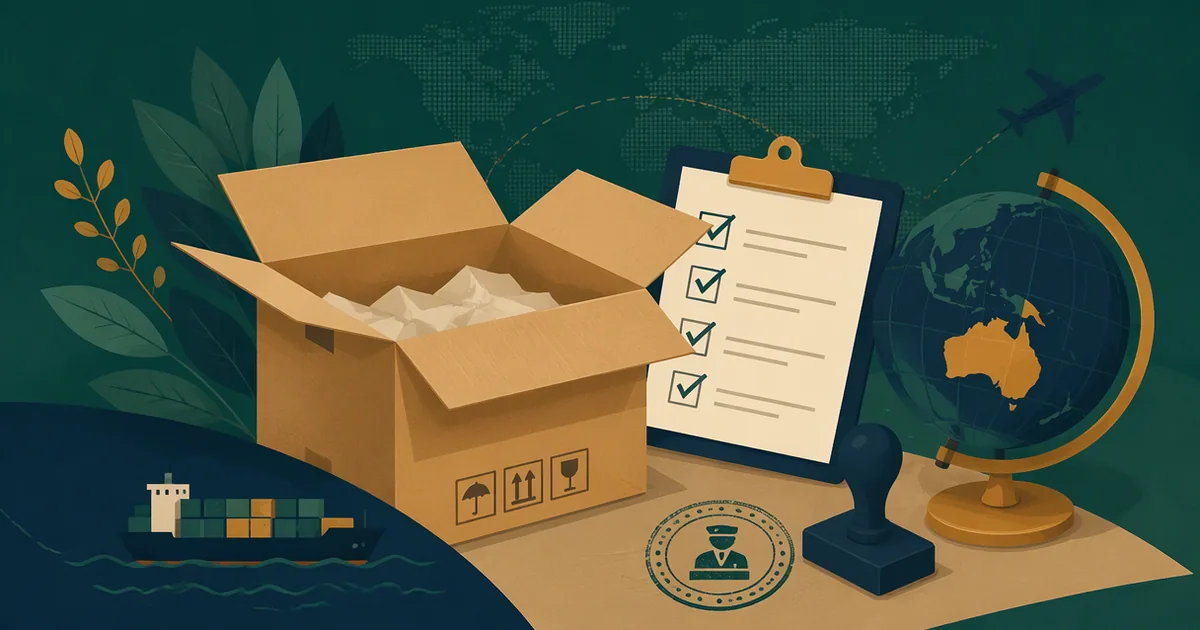
Getting Started: Importing into Australia
Free download: First Import Checklist (PDF) — every step below as a printable one-pager.
The end-to-end process
- Confirm your goods are allowed. Check the ABF prohibited/restricted list and BICON for biosecurity conditions. Some goods need permits before shipping.
- Get an ABN. Commercial importers need an Australian Business Number; it identifies you to the ABF and ATO.
- Classify your goods. Find the tariff classification (HS code) in the Working Tariff — this determines the duty rate and any restrictions. See the HS codes guide.
- Calculate landed cost. Duty + GST + freight + insurance + charges. Use our landed cost calculator.
- Arrange shipping and Incoterms with your supplier.
- Lodge a declaration. Under AUD 1,000: Self-Assessed Clearance (SAC). Over AUD 1,000: full Import Declaration via ICS.
- Pay duty/GST (or defer GST via the ATO scheme).
- Biosecurity clearance. DAFF inspects or releases goods based on BICON conditions.
- Comply with product rules before selling: labelling, safety standards, RCM, TGA, etc.
Which importer are you?
| Type | Typical path |
|---|---|
| Personal online shopper | Goods under AUD 1,000: usually nothing to do — GST collected at checkout by seller/marketplace. Over AUD 1,000: lodge an Import Declaration when Australia Post notifies you. |
| Traveller | Incoming Passenger Card; duty-free allowances AUD 900 (adults) / AUD 450 (under 18), 2.25 L alcohol, 25 g tobacco. Declare everything. |
| Small business / e-commerce | ABN + SAC/Import Declarations; check BICON, ACCC, labelling rules before ordering stock. See Importing for E-commerce. |
| Commercial importer (ongoing) | ABN, ICS registration, customs broker, GST deferral scheme, tariff concession/FTA planning. |
First-time importer checklist
- Product checked against ABF prohibited/restricted list
- BICON conditions checked (food, plant, animal, timber, used goods)
- HS/tariff classification confirmed and duty rate looked up
- ABN obtained (business)
- Landed cost modelled (product + freight + insurance + duty + GST + charges)
- Incoterm agreed with supplier (e.g., FOB, CIF, DDP)
- Supplier provides commercial invoice, packing list, Certificate of Origin (if claiming FTA)
- Import Declaration or SAC arranged (self or broker)
- GST deferral scheme applied for (if eligible)
- Labelling/product compliance sorted before sale
Use our interactive checklist generator to build a personalised version of this list.
Key thresholds
| Threshold | Consequence |
|---|---|
| AUD 1,000 | Below: no duty/GST at border (except alcohol/tobacco); above: full Import Declaration required |
| AUD 900 / 450 | Traveller duty-free general goods allowance (adult / under 18) |
| AUD 82.50 | Minimum tax-invoice value to claim GST credits |
Common mistakes
- Assuming "asbestos-free" overseas certification means asbestos-free by Australian standards (it doesn't).
- Shipping wooden packaging or goods with bark/soil without treatment.
- Under-declaring value — ABF reassesses, penalises, and can seize goods.
- Forgetting that GST applies to freight and insurance too (VoTI).
- Selling imported goods that don't meet ACCC mandatory standards — border clearance is not product-safety approval.